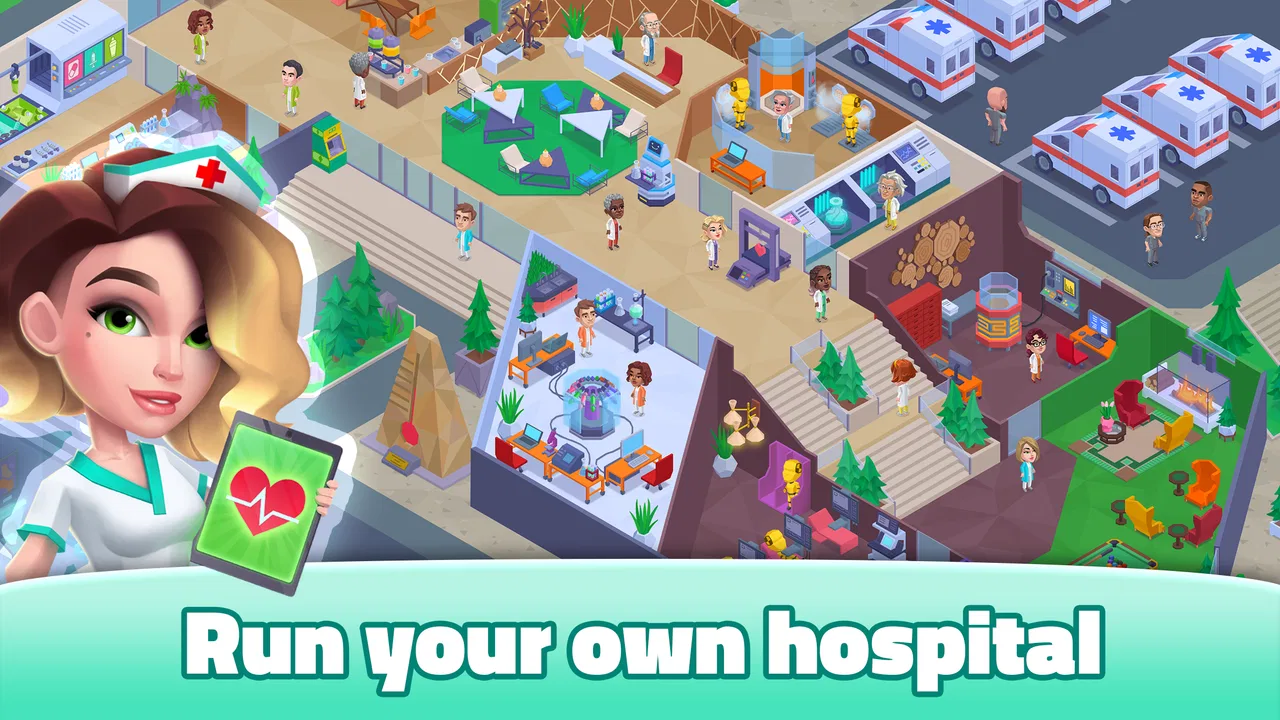
Happy Clinic: Hospital Game
- 4.3
- Rating
- 10.00M
- Installs
- Free
- Price

 Analysis by App-foxy
I went into Happy Clinic: Hospital Game expecting a light time-management game, and that is exactly where it feels most comfortable. You take charge of a busy hospital, move through patient-care tasks, and try to keep the whole place flowing before small delays turn into a bigger mess. It is a casual game from Nordcurrent Games, but it is not completely passive: the enjoyable part comes from making quick choices, noticing what is about to go wrong, and improving your next attempt.
The first thing I noticed is how quickly the game explains its basic appeal. I did not need a long tutorial or complicated controls to understand the central job. Patients arrive, needs appear, and I have to respond in a sensible order. The action is easy to grasp, yet the pressure gradually comes from handling several demands at once. That combination makes it approachable for short breaks while still giving me a reason to replay a stage instead of treating it as a one-time activity.
How the hospital loop feels in actual play
When I play a level, I find it helps to treat the room as a moving queue rather than a list of separate chores: one choice can make the next few easier or harder. I’ll look at how that rhythm rewards planning, and where it can feel demanding, before turning to the practical habits that make each attempt smoother.
You May Also Like

 Blood Strike: 2.5 Anniversary
Blood Strike’s Loadouts Turn Every Drop Into a Tactical Gamble
A close look at Blood Strike’s custom loadouts: how fast access to signature weapons reshapes its battle royale rhythm, rewards preparation, and narrows the gap between fights.

 Pandora - Music & Podcasts
Pandora’s Music Is Easy to Start, but Harder to Recover
Pandora’s strength is its low-effort path from a seed to a station. Its weak spot is how much confidence it asks you to place in connection, setup, and quiet recovery.

 8 Ball Pool
 Is Built on Rivalries, Rematches, and Routine
A close look at the rivalries, rematches, shared routines, and unanswered safety questions that turn a quick pool match into a persistent mobile community.

 Samsung Music
’s Quiet Strength Is Playing What You Already Own
Its reach comes less from spectacle than from dependable access to a personal library. That simplicity is both the app’s strongest retention engine and its ceiling.

 AccuWeather: Weather Radar
AccuWeather Review: A Quick, Clear Forecast for Everyday Decisions
For everyday plans, the best forecast is the one you can understand quickly. AccuWeather makes rain timing, radar, and local conditions easy to act on, with a few trade-offs.

 Hill Climb Racing
Why Hill Climb Racing Still Turns Crashes Into One More Run
A tiny car, a bumpy hill and one more upgrade: Hill Climb Racing keeps resurfacing because its simple chaos makes every near-miss feel personal.
More From Our News Desk
View All News


The first action is simple, but timing changes everything
My first move in a level is usually obvious: deal with the most immediate patient need. The interesting decision comes right after that. Should I finish the current task, prepare for the next request, or move attention to someone who may become a problem if left waiting? Happy Clinic works because the game turns ordinary hospital chores into small timing puzzles. I am not solving a difficult medical simulation; I am arranging actions under pressure.
That distinction matters. The game does not ask me to learn real clinical knowledge, so it is suitable for players who want the atmosphere of running a hospital without the weight of a serious management simulator. The challenge is about observation, movement, and prioritization. I can see why the game is classified as casual: the controls and goals are friendly, but a busy level can still demand concentration.
A useful habit is to look across the whole room before committing to the next action. When I focus only on the patient directly in front of me, I may complete one request efficiently and then discover that another situation has become urgent. A quick scan helps me plan a short route rather than reacting blindly. This is one of the small skills that makes later attempts feel better without turning the game into something complicated.
The hospital setting also gives the actions a clear purpose. Carrying out a task is not just tapping an icon for points; it contributes to keeping patients moving through the clinic. That visual connection makes the first action satisfying. I can immediately see whether my choice helped the room recover or merely shifted the delay somewhere else.
Feedback creates a steady rhythm of action and correction
Happy Clinic’s strongest quality is its feedback rhythm. I act, the hospital responds, and I quickly learn whether my timing was good enough. A smooth sequence creates the feeling that I am in control. A late decision produces a visible problem, which tells me what to change when I try again. That action-and-response pattern is more important here than any individual task.
I like games that explain failure through their systems rather than through a vague punishment, and this one generally gives me something understandable to react to. If I let several demands build up, the room feels harder to manage. If I prepare my next move and avoid unnecessary backtracking, the same kind of situation becomes much easier. The feedback encourages practical improvement instead of asking me to memorize a hidden solution.
There is also a pleasant change in pace between calm moments and crowded ones. At the beginning of a session, I can settle into the routine and identify what the level expects. Later, the same routine becomes a test of attention because several needs compete for priority. That escalation is what keeps the game from feeling like a collection of identical taps.
My main criticism is that this rhythm can become stressful for players who prefer completely relaxed casual games. The hospital theme suggests warmth and friendliness, but the most demanding moments still ask for fast decisions. Anyone looking for a quiet puzzle with no pressure may find the later action less comfortable than expected. I would recommend playing with the sound and pace that feel manageable rather than treating every level as something that must be perfected immediately.
Rewards work best when they support another attempt
The reward in a good time-management game is not only the result screen. For me, the real reward is seeing a messy sequence become orderly. When I finish a level with fewer mistakes, I feel that I have learned the room’s priorities. Progress then has a practical meaning: it gives me a reason to return and test whether I can handle the same kind of pressure more cleanly.
That is where the game earns its replay value. A first attempt often teaches me the shape of the challenge. A second attempt lets me adjust the order of my actions. I may decide to prepare for a predictable request earlier, avoid a needless trip, or deal with a waiting patient before the situation becomes crowded. These are modest improvements, but they make the loop feel personal rather than automatic.
Players should also understand the difference between enjoying progress and chasing perfect performance. If I treat every stage as a demand for flawless execution, the game can feel more demanding than its casual label suggests. If I view each run as information for the next one, the reward becomes more satisfying. The game is at its best when I use mistakes as a route planner instead of simply feeling punished by them.
There is a practical consideration around spending. The game is free to download and play, while optional in-app purchases range from $0.89 to $74.99 per item. That broad range means I would approach purchases carefully and decide in advance whether I want to spend anything. The core appeal is the action-feedback loop, so I would not recommend buying something just because a difficult session made me impatient. Free players can first decide whether the hospital routine genuinely holds their attention.
Why the next session begins after the reset
Each session has a natural reset point. Once I finish a level or reach the end of an attempt, the immediate pressure disappears and I get a moment to consider what happened. That reset is important because the game’s challenge depends on repetition. I am not expected to manage an entire hospital permanently in one uninterrupted run; I return to a fresh situation with a better understanding of my previous choices.
This makes the game especially suitable for short everyday sessions. I can play while waiting for an appointment, during a commute when I have a stable connection and enough attention, or at home when I want something more active than a simple matching game. A typical session might begin with me checking the first requests, become hectic as priorities overlap, and end with a quick mental note about the one decision that caused the biggest delay. That is enough closure to stop without feeling that I abandoned a huge open-ended task.
The reset also protects the game from becoming exhausting. A demanding level may require focus, but I can put it down and return later without needing to remember a large story or a complicated strategy tree. The trade-off is that players who want a deep, persistent simulation may find the structure too segmented. This is about improving your handling of repeated hospital situations, not building an endlessly detailed medical institution.
I would skip it if my main goal were a realistic hospital simulator, a story-heavy adventure, or a game with broad strategic control over staffing and finances. Happy Clinic is more immediate and tactile. It asks, “What should I handle next?” rather than, “How should I design this hospital over many years?” For that reason, a traditional management game may be a better choice for players who enjoy spreadsheets, long-term planning, and complex systems.
Small habits that make the loop more enjoyable
My first practical tip is to separate urgent actions from merely available actions. The game can tempt me to tap whatever is closest, but the nearest request is not always the best one to handle. I get better results when I consider which delay will create the largest chain of problems. That simple priority check makes crowded moments feel more manageable.
My second tip is to treat movement as part of the puzzle. A task may look easy in isolation, yet a poor sequence can make me cross the same area repeatedly. I try to group actions by location when the situation allows it, while still keeping an eye on patients whose needs cannot wait. The best route is not always the shortest route; it is the route that reduces future interruptions.
My third tip is to use a failed attempt as a diagnostic tool. Instead of restarting immediately out of frustration, I ask what changed first: did I ignore a waiting patient, choose a slow order of tasks, or spend too long finishing something that could have waited? Identifying that first mistake often gives me a clearer improvement than trying to move faster everywhere.
A fourth useful approach is to protect attention. Because the game’s appeal comes from reacting to several demands, playing while constantly switching between other apps or conversations can make the experience feel unfairly difficult. When I give it a few uninterrupted minutes, the feedback becomes clearer and the challenge feels more like skill than noise.
How it compares with other casual choices
Compared with a match-three game, Happy Clinic gives me more direct control over the outcome. I am not mainly waiting for a lucky board; I am choosing what to do and when. Compared with an idle game, it demands active attention rather than rewarding me for leaving the phone alone. Compared with a full management simulator, it removes much of the administrative weight and focuses on moment-to-moment service.
That middle position is its identity. I get the recognizable satisfaction of completing a chain of tasks, but I also have to watch the room and change plans. Players who enjoy restaurant time-management games may understand the appeal immediately, although the hospital theme gives the tasks a different emotional context. People who prefer decorating, collecting, or story progression above all else may find the repeated operational loop less compelling.
The game’s broad audience is reflected in its Everyone content rating and its accessible presentation. It is a reasonable choice for families who want a straightforward casual game, though the busiest stages may still be better suited to players who enjoy quick decisions. It also runs on Android six point zero or later, which makes it available to many older devices, provided the phone handles the current version comfortably.
What the current release means for choosing it
The current version is 17.0.2, and the game has been available since January 23, 2022. Its continued visibility is understandable: the core loop is easy to learn, and the hospital setting gives ordinary time-management actions a clear theme. With over ten million installs, it has reached a substantial audience, while its 4.3 average from roughly sixty-six thousand ratings suggests that many players find the overall package enjoyable.
I would still treat popularity as a starting point rather than a guarantee. The game’s fit depends on how I respond to repetition, pressure, and optional spending. Someone who likes improving a familiar routine will probably get more from it than someone who needs every session to introduce a completely new mechanic. The rating is encouraging, but my own preference would be decided by whether the action-feedback-reset pattern feels rewarding after several attempts.
One question I would ask before installing is whether it suits my available time. In my experience, it works well in compact bursts because the central task is immediately understandable. Another question is whether I want a free game with optional purchases. If I dislike any temptation to accelerate progress or buy extras, I would set a strict no-spending rule from the beginning and judge the game only by its free play.
I would also consider the device. The minimum operating-system requirement is Android six point zero, so compatibility is not limited to only the newest phones. Still, an older device may make a fast, crowded level less pleasant if performance is inconsistent. Since timing is central to the game, a smooth response matters more here than it would in a slow turn-based title.
My verdict on the complete action loop
Happy Clinic succeeds because every part of its loop has a clear job. The first action gives me an immediate problem to solve. The feedback tells me whether my priorities worked. The reward is the satisfaction of creating a cleaner sequence and moving forward. The reset gives me a fresh chance to apply what I learned, which is why another session feels inviting rather than compulsory.
I would recommend it to anyone who wants a friendly hospital-themed casual game with active time management, especially players who enjoy improving through short retries. It is also a good fit for people who like games that are easy to start but become more demanding when several requests compete. The strongest experience comes from playing attentively, learning the order of events, and accepting that a failed attempt can be useful.
I would not choose it for deep medical realism, extensive long-term planning, or a completely pressure-free pastime. The free-to-play structure and optional purchases also deserve sensible boundaries, particularly because the listed purchase range reaches from $0.89 to $74.99 per item. But if I want a casual game that turns a few spare minutes into a small, readable challenge, this is a convincing option.
My final view is positive, with one condition: enjoy the process more than the perfect result. The hospital becomes fun when I notice the rhythm between action, consequence, reward, and restart. That rhythm gives Happy Clinic: Hospital Game enough personality to stand apart from simpler tap-and-wait alternatives, while keeping the controls approachable for newcomers. Choose it for quick decisions and repeatable improvement, not for a full hospital-management simulation.
FAQs for Happy Clinic: Hospital Game
01What is Happy Clinic: Hospital Game about?
Happy Clinic: Hospital Game is a time-management and hospital simulation game in which you help doctors and nurses treat patients, organize medical facilities, and improve hospital operations. You begin with basic equipment and gradually expand your clinic by completing treatment tasks, serving patients efficiently, and unlocking new departments, locations, tools, and upgrades as you progress.
02Is Happy Clinic: Hospital Game free to download and play?
Yes, Happy Clinic: Hospital Game can generally be downloaded and played for free, although it may include optional in-app purchases. These purchases can provide extra currency, boosters, upgrades, or other conveniences, but they are not necessarily required to enjoy the main progression. Players should also check the store listing for the latest pricing and availability in their region.
03Does the game require an internet connection?
Some features of Happy Clinic: Hospital Game may require an active internet connection, particularly advertisements, cloud-related services, purchases, events, or promotional rewards. Basic gameplay may work in certain situations without a connection, but offline availability can vary depending on the device and version. For the most reliable experience, it is recommended to launch the game while connected to the internet.
04Are advertisements and in-app purchases included?
Happy Clinic: Hospital Game may display advertisements and offer optional in-app purchases. Ads can sometimes be used to receive additional rewards or speed up progress, while purchases may provide premium currency, bundles, or helpful resources. Before downloading, parents and players should review the device’s purchase settings, especially if children will be playing, because spending can accumulate quickly.
05Is Happy Clinic: Hospital Game suitable for children?
The game uses colorful graphics, simple hospital-management mechanics, and non-graphic medical situations, making it generally approachable for a broad audience. However, its age rating may differ between Android and iOS, and advertisements or optional purchases may be present. Parents should review the official store rating, privacy information, and available parental controls before allowing younger children to play.
Pros
- Simple controls make the hospital tasks easy to learn.
- Short levels suit quick gaming sessions on mobile.
- Unlockable rooms add a steady sense of progression.
- Bright visuals make the clinic feel friendly and approachable.
- Offline play is useful when you have no internet connection.
Cons
- Repeated tasks can make later levels feel predictable.
- Upgrade costs may encourage frequent grinding for coins.
- Small screen text can be difficult to read on some phones.
- The game may become demanding as patient queues grow.
- Ads can interrupt play unless removed through an in-app purchase.

Happy Clinic: Hospital Game
Gallery